
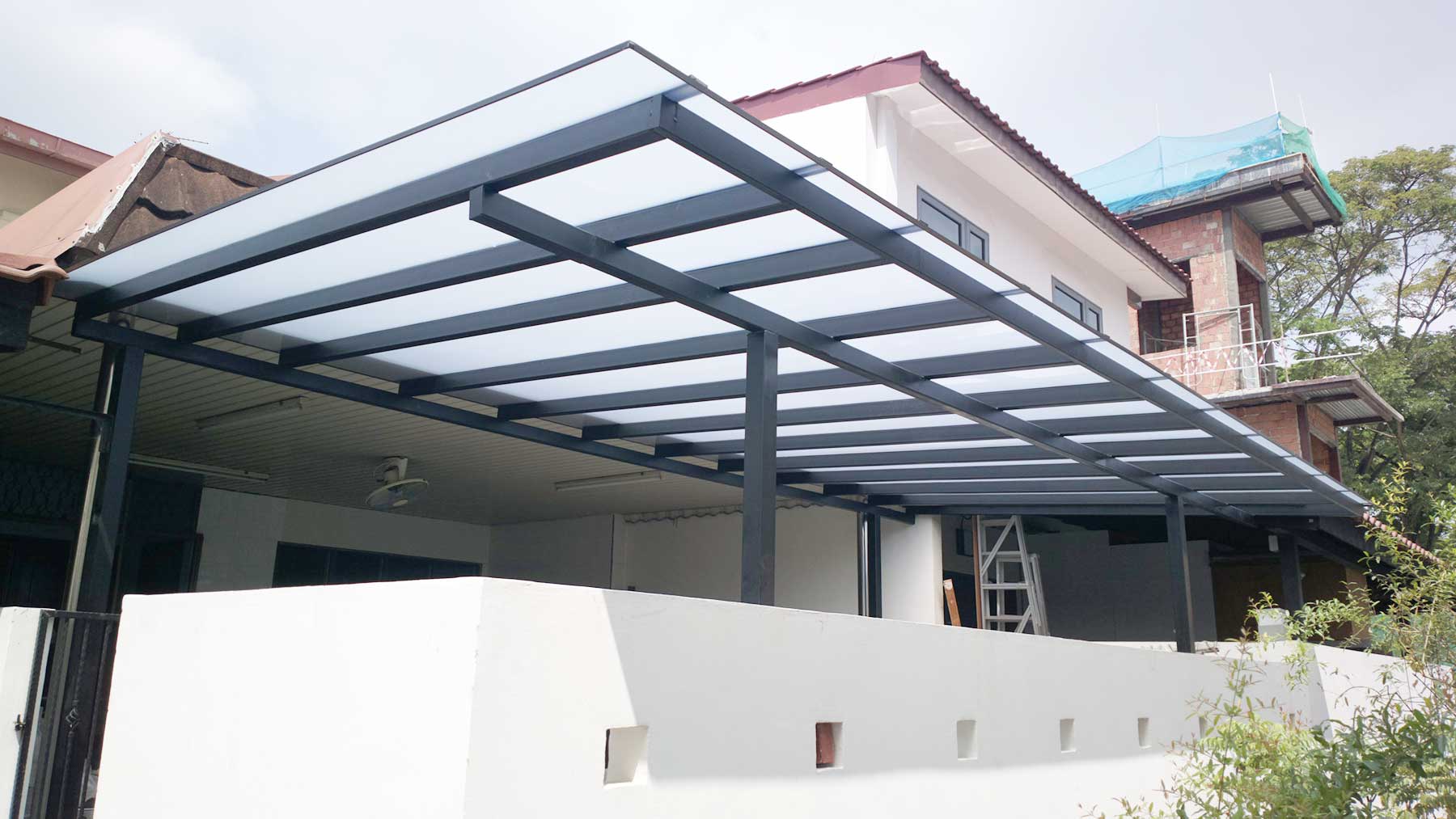
Simple backyard polycarbonate roof
Polycarbonate solution provides good acoustical insulation and maximise your outdoor living space and lifestyle. The advantage of polycarbonate roofing and awning is its high impact resistance being practically unbreakable in some instances as its material is much tougher than glass.
Polycarbonate roofing and awning is an easy and simple way to build the perfect look for your home and capable of lasting for many years without requiring maintenance. Trellises add a relaxed resort-like charm to any building. They are fitted with polycarbonate sheets which let in natural light while reflecting ultra-violet rays.

Trellis shade for semi-outdoor areas

Frame supporting tinted panels

Roofing for high ceiling
Information
Polycarbonate roofing, in its nature, is neither new nor ornamental, yet it has found its place quietly in modern homes. It is a thermoplastic material, light in the hand and forgiving in use, which allows builders to work without forcing the structure beneath it. Because it carries little weight, it does not burden trellises or pergolas, whether placed above a car porch, a balcony, or a small garden corner. Those who have handled compact discs before will recognise its resilience; it bends before it breaks, and even when drilled, it remains intact. Light passes through it gently, not harshly, giving shelter without darkness and reducing the need for artificial lighting during the day. Over time, it holds its colour better than many alternatives, resisting the tired look that often comes too quickly. When rain falls, the sound is softened, and heat does not gather as it does beneath metal sheets. In this way, polycarbonate does not demand attention, but proves its value by lasting quietly, doing what is needed, and little more.
Design and Structure
Polycarbonate is a kind of thermoplastic material that can be used for Roofing, thus, commonly known as Polycarbonate Roof or Polycarbonate Roofing
Advantages of Polycarbonate
- Lightweight – Polycarbonate sheets are light and do not add unnecessary weight to your trellis roof. This makes it a great material for your trellis at your car porch, patio, balcony, garden, roof terrace and private enclosed spaces (PES).
- Virtually unbreakable – CDs and DVDs are made of polycarbonate as well. If you’ve ever tried to destroy an old CD of your old (and unwanted) memories, you’ll know what I mean.
- High impact resistance – That’s why we can drill holes in it without it breaking. This makes it a good material to work with as we can attach it to your trellis or pergola structure without it cracking.
- Light passes through it – There are see through options that allow light to pass through. This provides for natural light, and lower energy bills.
- It doesn’t discolour or fade easily – Who wants to spend time and money building a trellis only to have it look old within a year or two?
- It’s a great heat and sound insulator – Definitely less deafening in a thunderstorm than aluminium roofs.
Cons of Polycarbonate
There is but one characteristic of Polycarbonate that we think can be improved. Polycarbonate is not entirely scratch resistant. So if you’re thinking of using it where there’ll be lots of contact, you may find scratches appearing soon. However, when used as a trellis or pergola roof, the chances of it getting scratched are pretty low. So you can use it with peace of mind.
Balancing daylight and covered space
Before choosing a polycarbonate roof, consider what the covered area needs to do. A walkway may need dependable overhead coverage without making adjacent rooms too dark. A sitting area may place more emphasis on reducing glare. A car porch needs the proposed roof to work with vehicle access and the entrance. These uses can lead to different preferences for panel colour, light transmission and the extent of coverage.
Look at the area during the hours you use it most. The direction of sunlight, nearby walls and existing windows all influence how a finished roof feels. A darker panel is not automatically the best answer for every property. Compare the proposed sheet specification and samples, then discuss the balance between daylight and shade for the actual location. Performance depends on the selected panel and the complete installation.
Planning the structure and drainage
The supporting frame, roof slope and drainage route deserve as much attention as the panel finish. Water should have a planned path away from the covered space, with accessible gutters or outlets where applicable. Existing pipes, windows and air-conditioning equipment can affect the arrangement. Connections to the building should be assessed rather than treating the new cover as a sheet placed over an empty space.
Our car porch roofing page covers access and coverage considerations for vehicle shelters. For outdoor seating, compare the requirements described in patio and garden shade solutions. An initial enquiry is more useful when it includes photographs of the full area, the existing roof edge and the surfaces where supports or fixings may be proposed.
Approval requirements depend on the work and property. Review BCA’s guidance on building works and approval requirements and obtain the relevant professional or management advice before proceeding. An exemption from one approval process does not remove other applicable requirements.
Keeping the roof in useful condition
Plan for safe access to maintain drainage and remove accumulated leaves. Follow the cleaning recommendations for the supplied panels, particularly where coatings or surface treatments are involved. Avoid using abrasive materials or assuming that any household cleaner is suitable. Routine observation of gutters, joins and visible fixings can help identify changes early.
If you notice staining, dripping at a joint or unusual movement, share photographs and explain when it occurs. The panel, connection and drainage arrangement should be considered together when deciding the next step.
Frequently Asked Questions
| Question | Answer |
|---|---|
What are the advantages of polycarbonate roofing? | It's lightweight, virtually unbreakable, highly impact-resistant, lets light through, resists discolouring, and provides good heat and sound insulation. |
Where is polycarbonate roofing commonly used? | On trellises and pergolas over car porches, patios, balconies, gardens, roof terraces, and private enclosed spaces. |
Does polycarbonate roofing scratch easily? | It's not entirely scratch resistant, though scratching risk is low when used as trellis or pergola roofing with minimal contact. |
Does polycarbonate roofing block UV rays while letting light in? | Yes, it lets natural light through while reflecting ultra-violet rays. |
How long does polycarbonate roofing last? | It's designed to last many years without requiring much maintenance, according to the page. |